
How AI rewrote our cost structure, why a ten-hour job now takes four, and where the sixty percent saving on your build actually comes from.
Two weeks ago we sent a client a proposal with no line item for writing code. They asked, politely, whether it was a mistake.
It was not. We have stopped charging clients for the work of writing code.
This is not a positioning gimmick and it is not a discount dressed up as a principle. It is the only honest position to take given what code now costs to produce. A senior developer at HDL, working inside Ariane, our internal AI delivery layer, with Claude scaffolding, Codex validating and a human engineer making the final call, ships in a fraction of the time we used to bill for. We did the arithmetic. If we kept charging for that work at the old rate, we would be selling our clients a fiction.
So we stopped. Below is how the pipeline runs, what we still charge for, and why the bill at the end of a project lands at roughly forty percent of what a traditional Swedish agency would quote for the same outcome.
What does it mean to stop charging for code?
It means the line on the invoice that used to read ”development, so many hours at so much per hour” is gone. We do not meter the typing anymore, because the typing is no longer where the cost or the value lives.
That sounds radical until you look at what writing code became. The first draft of a function, a component, a migration, a piece of glue between two systems, is now produced in minutes by a model that has read more code than any human on our team ever will. Charging a day rate for something that takes twenty minutes is not a business model. It is a countdown.
The work that remains is real, and it is what you are paying for. It is just not the part anyone romanticised.
How does the pipeline actually run?
The moment-by-moment work of building software at HDL no longer looks like one developer typing in an editor. It looks like a sequence, most of it running inside Ariane, with a senior engineer accountable at the end.
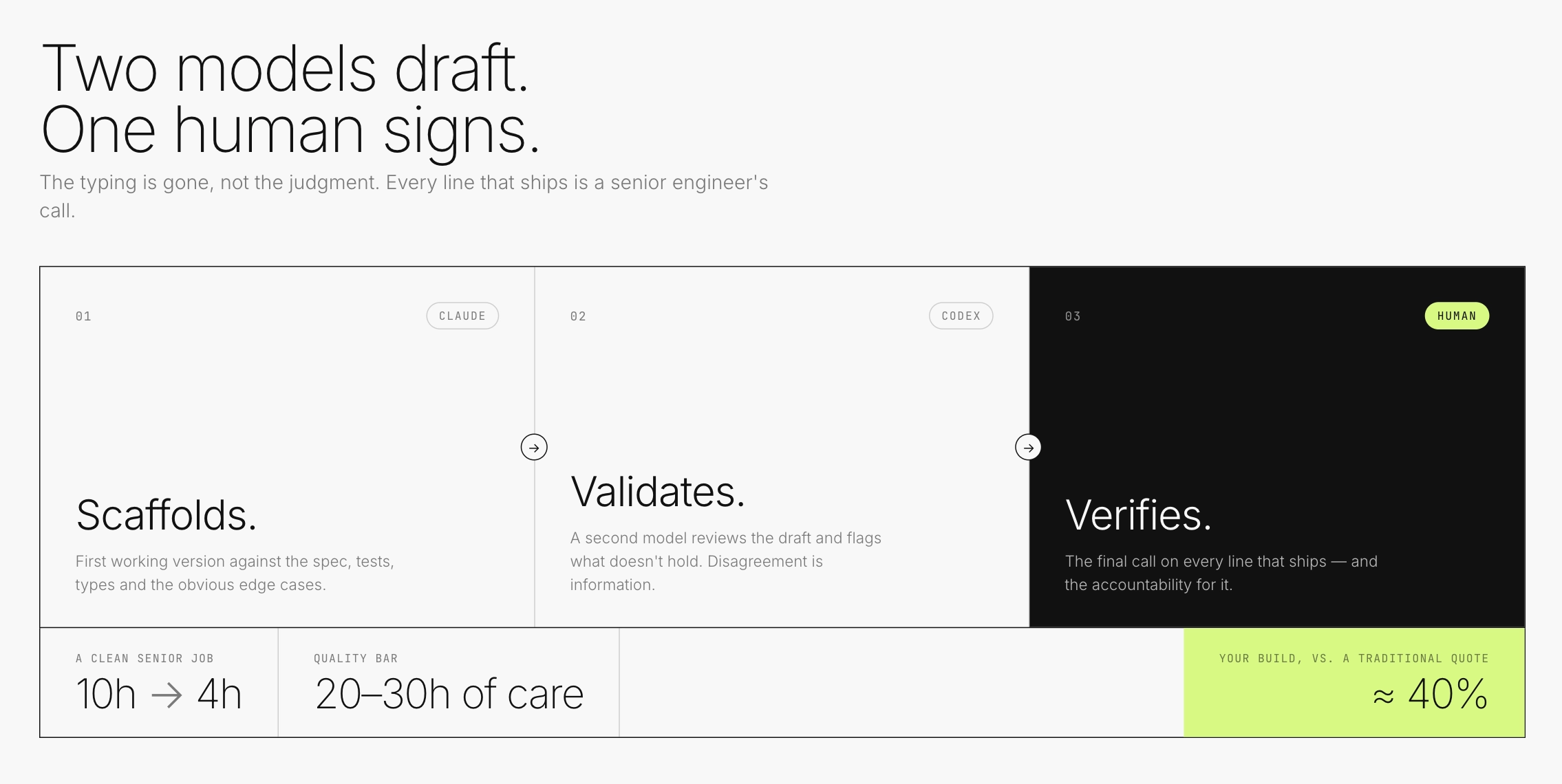
Claude scaffolds. For a typical feature in an HDL Flagship build, Claude is the first hand on the keyboard. It produces the first working version against the spec, the tests, the types, the obvious edge cases. This is the part that used to eat the morning.
Codex validates. The draft does not go straight to a human. A second model reviews it against the specification, looks for the mistakes a first pass tends to make, and flags what does not hold together. Two models disagreeing is information. It tells the engineer exactly where to look.
A human verifies. A senior engineer makes the final call on every line that ships, and is accountable for it regardless of which tool produced the first draft. The pipeline removed the typing, not the judgment, and not the responsibility.
A concrete example. A piece of work that was a clean ten-hour manual job for a senior developer now takes about four. The output is not ten hours of quality. It is closer to the twenty or thirty hours of quality you would get from a careful engineer with infinite patience, because the validation step catches what a tired human misses at hour eight.
So what are we charging for?
Six things, and none of them is typing.
Strategy. Deciding what to build and what not to build. The most expensive line of code is the one that solves the wrong problem, and no model decides that for you.
Taste. The hundred small judgments that separate software that works from software that feels right. Where the friction should sit. What to leave out. This is craft, and it does not fall out of a prompt.
Vertical expertise. Eight years building for performance, marine, outdoor and sport brands. We know your category before the first meeting. A studio that has to learn it learns it on your budget.
Integration. Making the pieces work together, with your existing systems, your data and your team. This is where most projects actually fail, and it is stubbornly human work.
Accountability. One partner who owns the outcome, signs their name to it, and is still there when something breaks at an awkward hour. AI does not carry accountability. We do.
Operations. Keeping the thing running, monitored and improving after launch, which is what HDL Operate exists for.
That is the bill. Strategy, taste, expertise, integration, accountability and operations. The code more or less writes itself now. The reasons to trust the result do not.
Where does the sixty percent saving come from?
Not from cutting quality, and not from junior labour. It comes from removing the hours that used to be pure friction.
A traditional agency quotes the old way: estimated hours times a rate, with a quiet buffer for everything that goes wrong. The buffer is real, because in the old workflow plenty went wrong, and slowly. When the input cost of producing software collapses and you keep quoting the old way, the gap between the quote and the real cost becomes pure margin you are charging the client to absorb.
We stopped absorbing it and started passing it back. The same outcome, the same quality bar, often higher, at roughly forty percent of the old quote. The forty percent pays for the six things above. The sixty percent was never really about the code.
Does this make the work lower risk for you?
Yes, and that is the part most clients feel before they can name it.
When the price is hours, you carry the risk of the estimate being wrong. When the price is fixed and the scope is clear, that risk sits with us, where it belongs. This is why our engagements run on fixed scope, fixed price and a fixed date. An HDL Flagship for a new digital home. HDL Intelligence to put a production AI capability inside an existing business. HDL Commerce as a platform alternative to Shopify Plus and Centra. HDL Operate to keep it all running afterward.
The model is in the workflow, not just in the demo. That is the difference between an agency that talks about AI and a studio that rebuilt around it.
Where to start
If this argument lands, the cheapest door in is an HDL Discovery Sprint. Two weeks, fixed price. You walk away with a working prototype, a real architecture and a real number, not a proposal full of estimates. No hourly games, no buffer hidden in the quote.
We stopped charging for code because charging for it had stopped being honest. What you pay for now is the part that was always worth paying for.